Your Blood Was Never Blue — But Textbook Publishers Accidentally Convinced an Entire Generation It Was

The Biology "Fact" That Isn't Actually True
Ask a random group of American adults what color blood is inside your body, and you'll get a surprisingly divided response. While most people correctly answer "red," a significant minority will confidently tell you that blood without oxygen is blue. They'll explain that deoxygenated blood in your veins appears blue, which is why you can see blue lines under your skin, and it only turns red when exposed to oxygen.
This explanation sounds logical, feels scientific, and is taught with such confidence that questioning it seems almost foolish. There's just one problem: it's completely wrong. Your blood is never blue, under any circumstances, anywhere in your body.
The Textbook Shortcut That Fooled Everyone
The blue blood myth traces directly back to educational publishing decisions made decades ago. Anatomy textbooks and classroom diagrams needed a way to help students distinguish between arteries (which carry oxygenated blood) and veins (which carry deoxygenated blood). Publishers chose red for arteries and blue for veins — a clear, visually distinct color scheme that made complex circulatory diagrams easy to read.
This was purely a design choice, like using different colors to represent different subway lines on a transit map. Nobody intended to suggest that blood actually changes color based on oxygen content. The blue was meant to be symbolic, not literal.
But somewhere between the publisher's design room and millions of American classrooms, the visual aid became biological fact. Students looking at these diagrams began assuming that blue represented the actual color of venous blood. Teachers, many of whom had learned from the same textbooks, reinforced this interpretation. The color-coding system designed to clarify blood flow accidentally created a widespread misconception about blood composition.
What Deoxygenated Blood Actually Looks Like
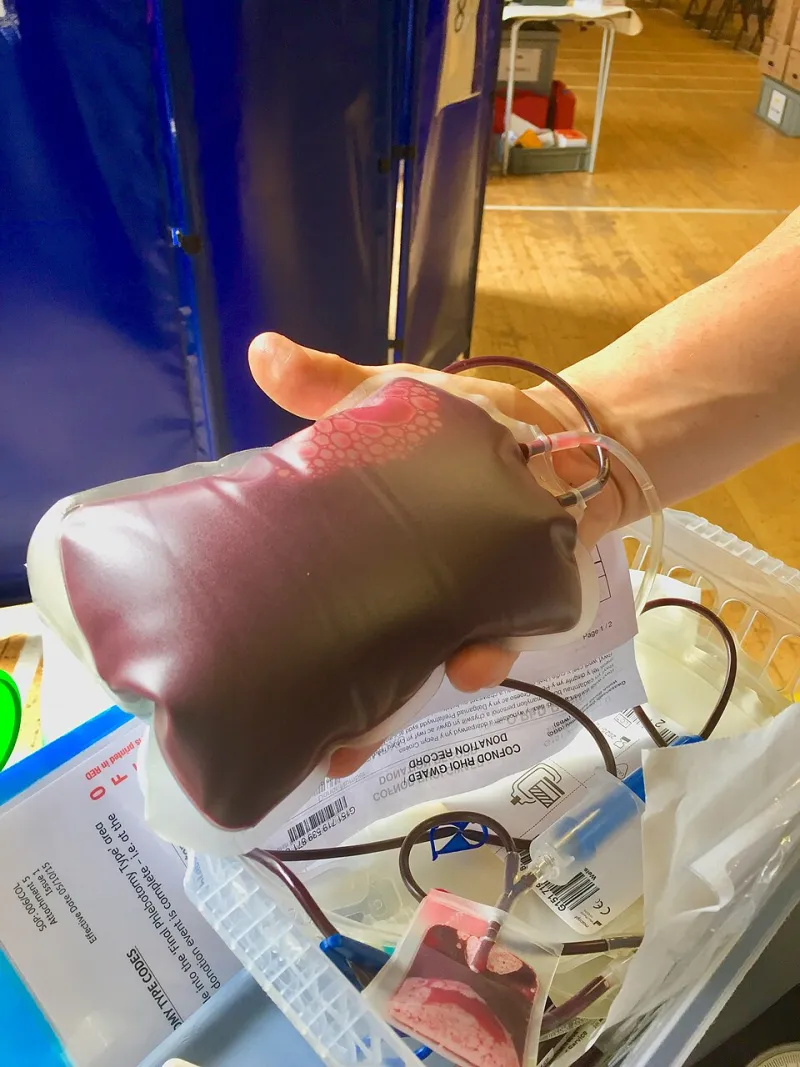
Real blood, whether oxygenated or deoxygenated, ranges from bright red to dark red. When blood carries lots of oxygen, it appears bright scarlet red. When blood has delivered its oxygen to tissues and returns through veins, it becomes a darker, more maroon red — but it's still definitively red.
You can observe this yourself during any blood draw. The blood flowing into collection tubes from your veins is dark red, not blue. Medical professionals who work with blood daily — surgeons, nurses, lab technicians — never encounter blue blood because blue blood doesn't exist in healthy humans.
The darkest venous blood might appear almost purple in certain lighting conditions, but it never approaches anything that could reasonably be called blue. The color difference between arterial and venous blood is subtle — more like the difference between bright red and burgundy than between red and blue.
Why Your Veins Look Blue Through Your Skin
If blood is always red, why do veins appear blue or green through your skin? The answer involves physics, not biology. When light penetrates your skin to illuminate blood vessels underneath, different wavelengths behave differently.
Red light penetrates deeper into tissue than blue light. This means red light can reach deeper veins and reflect back to your eyes, while blue light tends to scatter and reflect from shallower layers. The combination of light scattering, skin pigmentation, and the depth of blood vessels creates the blue or green appearance you see.
This optical effect is similar to why the ocean appears blue even though water itself is colorless. The blue appearance comes from how light interacts with the medium, not from the actual color of the substance itself.
Interestingly, this same optical principle explains why deeper veins often appear more blue than shallow ones, and why vein color can vary based on skin tone, lighting conditions, and individual anatomy.
How Educational Shortcuts Become "Facts"
The blue blood myth reveals a fascinating problem in education: visual aids designed to simplify learning can accidentally create new misconceptions. Publishers and educators face constant pressure to make complex topics accessible, leading to shortcuts and simplifications that sometimes go too far.
Diagrams showing blue veins and red arteries work brilliantly for teaching blood circulation patterns. Students can easily follow the flow of blood through the heart, lungs, and body when each pathway has a distinct color. The problem arises when students (and sometimes teachers) forget that the colors are symbolic rather than literal.
This pattern repeats across many subjects. Maps showing different countries in different colors don't mean those countries are actually different colors from space. Atomic diagrams showing electrons as tiny balls orbiting a nucleus don't mean electrons actually look like colorful spheres. But educational shortcuts like these occasionally escape their intended context and become accepted as factual descriptions.
The Persistence of Visual Learning
Visual learning is incredibly powerful, which explains why the blue blood myth has such staying power. People remember images more easily than verbal explanations, and the bright, clear diagrams showing blue veins create lasting mental impressions. When someone later tries to correct the misconception with words alone, they're fighting against a vivid visual memory.
This creates a particularly stubborn type of misinformation. People who believe blood is blue aren't being careless or anti-scientific — they're remembering exactly what their textbooks showed them. The problem isn't their learning ability; it's that the educational materials accidentally taught them something false alongside something true.
Medical Education Gets It Right
Interestingly, this misconception rarely survives actual medical training. Students in nursing school, medical school, or other health programs quickly encounter real blood and real anatomy. The first time they see blood drawn from a vein, assist with surgery, or work in a lab, the blue blood myth evaporates instantly.
This suggests that hands-on experience is often the most effective way to correct misconceptions created by simplified educational materials. Abstract knowledge, even when wrong, can persist for years until it encounters concrete reality.
The Bigger Picture
The blue blood story isn't really about blood — it's about how educational design choices can have unintended consequences that last for generations. Publishers created a useful visual tool that accidentally became a biological fact in millions of people's minds.
This matters because it illustrates how easily false information can spread through authoritative channels. When textbooks, teachers, and educational institutions all reinforce the same misconception, it becomes incredibly difficult to recognize and correct.
What This Means for Everyone
The next time you look at veins through your skin and see blue or green, remember that you're witnessing an optical effect, not the actual color of your blood. Your blood has been red since before you were born, and it will stay red throughout your entire life.
More importantly, remember that educational shortcuts — even ones created with the best intentions — can sometimes teach us things that aren't quite true. The most confident-sounding "facts" are worth questioning, especially when they come from simplified explanations designed to make complex topics easier to understand.