Your Phone Isn't Keeping You Awake — What You're Doing With It Is
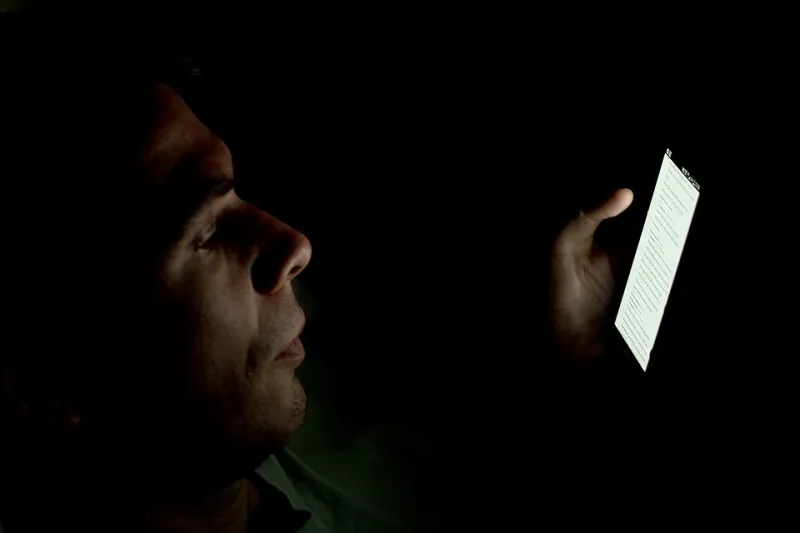
Photo: Japanexperterna.se from Japan, CC BY-SA 2.0, via Wikimedia Commons
If you've ever turned on your phone's Night Mode before bed, switched to a warmer screen tone after 9 p.m., or worn those slightly odd amber-tinted glasses while watching TV, you've participated in one of the more widespread tech-health rituals of the last decade. The logic feels airtight: blue light from screens suppresses melatonin, melatonin tells your brain it's time to sleep, therefore blue light keeps you awake. Simple, clean, and repeated confidently by everyone from sleep coaches to pediatricians to the settings menu of your iPhone.
The problem is that the science behind it has always been messier than that tidy chain of reasoning suggests — and more recent research has started pulling on some threads that unravel the story pretty significantly.
Where the Blue Light Theory Came From
The foundation is real. Light does affect your circadian rhythm. Specifically, specialized cells in the retina called intrinsically photosensitive retinal ganglion cells (ipRGCs) are sensitive to short-wavelength light — the blue end of the visible spectrum, roughly 460–480 nanometers. These cells connect to the suprachiasmatic nucleus, the brain's internal clock, and help it calibrate day and night. Bright blue-spectrum light in the morning helps you feel alert. Exposure to it late at night can theoretically delay the release of melatonin.
That's the legitimate science. What happened next was a classic case of reasonable extrapolation running ahead of the actual evidence.
Researchers established the blue light–circadian connection largely through studies using high-intensity light sources at levels far exceeding what a phone screen emits. The leap from "extremely bright blue light in a lab setting affects sleep timing" to "your phone screen before bed is ruining your sleep" was a significant one — and it got made quickly, loudly, and commercially.
What More Recent Studies Actually Found
A 2021 study from the University of Manchester turned the conventional wisdom on its head in an interesting way. Researchers found that it wasn't just the wavelength of light that mattered, but its brightness and color temperature together. And they found that warmer, dimmer light was actually less disruptive to the circadian system than brighter light of any color — suggesting that a dimly lit phone screen, even without a blue light filter, might matter far less than assumed.
Other studies looking directly at real-world phone use found that blue light filtering apps had minimal measurable effect on sleep outcomes for most users. The University of Glasgow published research in 2021 involving over 167,000 participants that found the association between screen time and poor sleep was driven far more by when and how people used their phones than by the spectral properties of the light those phones emitted.
To be fair, this doesn't mean blue light has zero effect on anyone. People with certain sensitivities, shift workers, and individuals with specific sleep disorders may have more pronounced responses to light exposure. The biology isn't imaginary. But for the average person lying in bed scrolling through Instagram, the wavelength of the light hitting their retinas is probably not what's keeping them up.
The Real Sleep Disruptor Hiding in Plain Sight
Here's where the story gets more uncomfortable, because the actual culprit is behavioral — and behavioral problems are harder to sell a product to fix.
What phones reliably do is keep your brain cognitively and emotionally engaged at a time when it needs to be winding down. Checking the news triggers anxiety. Scrolling social media activates comparison and social processing. A tense text conversation elevates your heart rate. A compelling video keeps your attention spiked. None of these effects require blue light to explain. They're just what mentally stimulating, emotionally loaded content does to an aroused nervous system right before it's supposed to shift into sleep mode.
There's also the displacement factor. Every minute you spend on your phone in bed is a minute you're not sleeping. Sleep researchers call this "bedtime procrastination" — the phenomenon of voluntarily delaying sleep despite having no real reason to stay awake. It's remarkably common, poorly understood by the people doing it, and has nothing to do with photons.
The phone's light might marginally shift your melatonin timing by a few minutes. The hour you spent doomscrolling when you meant to sleep at 10:30 shifted your sleep by 60.
Why the Blue Light Story Stuck
The blue light narrative had a lot going for it culturally. It gave people a mechanical, biological explanation for a problem — bad sleep — that felt out of their control. It translated a vague behavioral issue into a specific, solvable technical problem. And critically, it was fixable with a product: a filter, a setting, a pair of glasses. That's a story that markets itself.
Tech companies leaned in. Apple introduced Night Shift in 2016. Android followed. Blue light glasses became a retail category worth hundreds of millions of dollars. None of these things are necessarily harmful — a warmer screen tone before bed isn't going to hurt you. But they may have given a lot of people the comfortable feeling of having addressed their sleep problem without actually addressing it.
The Takeaway
Your phone screen's blue light is a minor character in the story of why Americans sleep badly. The major character is what you're doing with the phone — the mental stimulation, the emotional engagement, the hour you didn't notice disappearing. Turning on Night Mode isn't wrong, but if you're doing it and then spending another 90 minutes in bed watching videos, you've treated the footnote and skipped the chapter.